Skincare Packaging
P&G University Partnership

Project Overview
Our team partnered with P&G to research, evaluate, and redesign e-commerce skincare packaging that meets both SIOC (Ships in Own Container) shipping requirements and real user needs.
To ground our design decisions in user behavior, we conducted three rounds of user research across in-home contextual visits and on-site sessions with 10 participants --> uncovering behavioral patterns, sensory preferences, and unmet functional needs that existing packaging failed to address.
Qualitative findings were synthesized into user profiles, task analyses, and usability requirements that drove iterative prototyping and evaluation. Each design decision was traceable back to a specific user need or identified risk area in the current product experience.
This project is protected by a 5-year Non-disclosure agreement.
Final deliverable visuals are omitted, but the research process, methodology, and reflections are shared in full below.
Tools
Adobe Illustrator, Correl Draw, Autodesk Fusion, Figma, Microsoft Office
Duration
10 weeks, 2025
Team
Myself, Tate Mazer, Jason Tothy, Alice Wu, Fan Yang
Process
Design Framework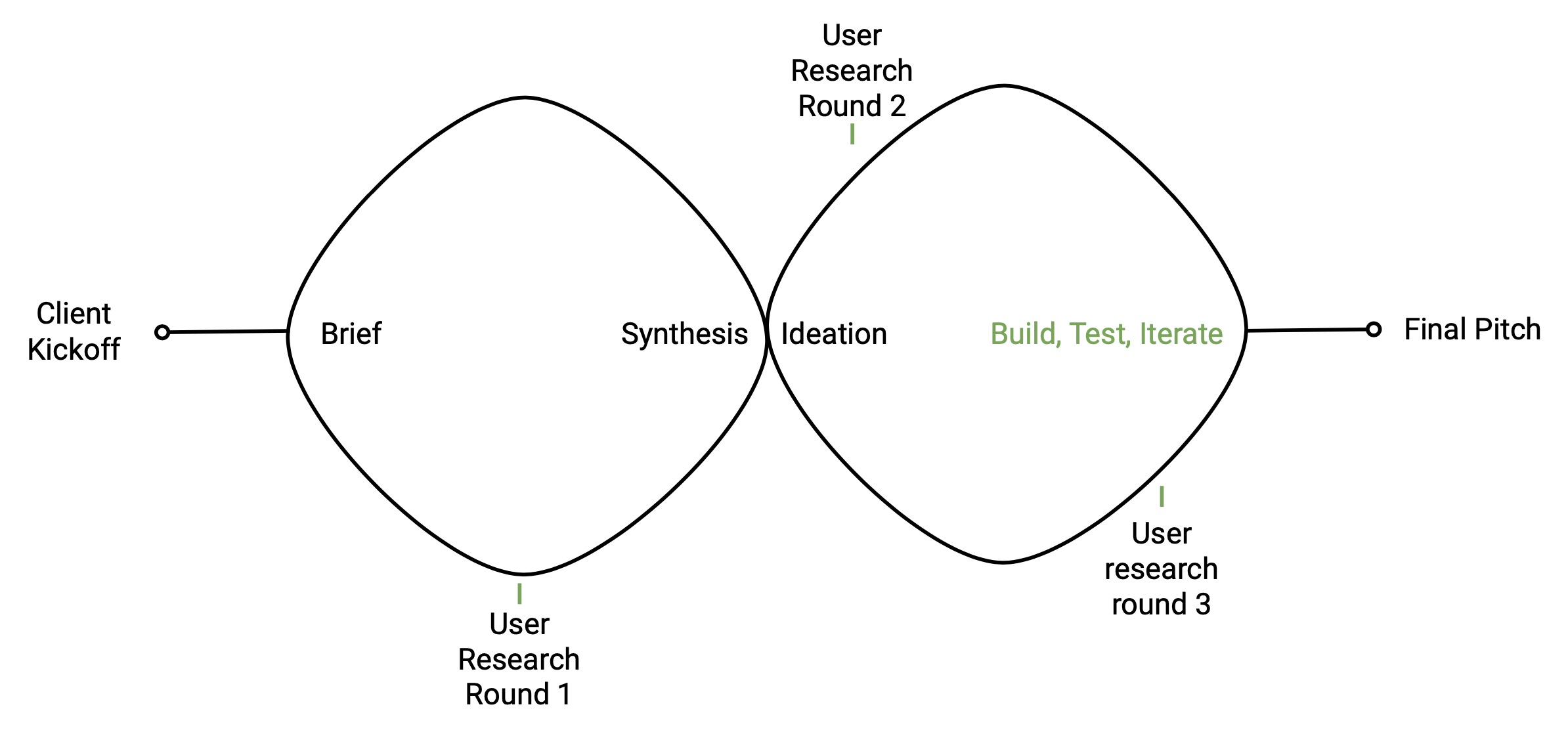
Empathize
Key Activities: Secondary Research · In Home Visits
·
How Might We’s · Tensions · Journey Map · Insights & Frameworks 
Mapping of Interview Insights from In Home Visits
Using in-home contextual visits, we observed participants interacting with their current skincare products and packaging in their natural environment. These methods supported us in capturing behavioral patterns, workarounds, and points of friction that self-reported surveys would have missed.
Data from 10 participants was synthesized into user profiles, a consumer journey map, and a set of core tensions that revealed gaps between users' mental models and the packaging's actual behavior. These insights were translated into "jobs to be done" statements that anchored our How Might We questions and were iteratively refined as new data emerged in all three research rounds.
Data from 10 participants was synthesized into user profiles, a consumer journey map, and a set of core tensions that revealed gaps between users' mental models and the packaging's actual behavior. These insights were translated into "jobs to be done" statements that anchored our How Might We questions and were iteratively refined as new data emerged in all three research rounds.
Define
Key Activities: Brainstorm · Consumer Site Visit 1 & 2 · Prototype Sketches · Storyboards · Design Requirements
Comparing P&G's existing product line against the behavioral needs and failure points uncovered in research, we identified a focused opportunity: an outer SIOC with a custom inner filler designed to reduce damage-related user frustration and elevate the unboxing experience.
To validate and prioritize design directions, we conducted two rounds of structured on-site sessions using card sorting, preference ranking, and mix-and-match exercises with 12 prototype concepts. We applied formative evaluation methods to understand how users interacted with and interpreted different packaging configurations before committing to a direction.
These three rounds of research culminated in a final set of functional and usability requirements, each directly tied to an observed user need or identified risk in the existing experience.
To validate and prioritize design directions, we conducted two rounds of structured on-site sessions using card sorting, preference ranking, and mix-and-match exercises with 12 prototype concepts. We applied formative evaluation methods to understand how users interacted with and interpreted different packaging configurations before committing to a direction.
These three rounds of research culminated in a final set of functional and usability requirements, each directly tied to an observed user need or identified risk in the existing experience.

Card Sorting Activity from Site Visit 2
Ideate + Prototype
Key Activities: Sketch · Rapid Prototyping
· Lasercutting
· Brainstorm/Solostorm
 Midterm Presentation of Research Findings with P&G
With finalized usability requirements in hand, the team moved into rapid ideation using brainstorming and individual solostorming. We generated 5 distinct design concepts, each taking a different approach to the outer SIOC and inner filler interaction. Concepts were evaluated against our requirements matrix before being brought into physical form through laser cutting and 2D/3D modeling.
Iterate + Test
Key Activities: CAD (Render & Assembly)
·
Lasercutting
·
Color Material Finish
·
Branding
Over two weeks, we rapidly iterated on opening mechanisms, material choices, and structural features. We conducted internal evaluations within our 27-person cohort and faculty reviewers to assess usability, preference, and perceived quality.
Preference data and qualitative feedback narrowed the field to 3 finalist designs, which were presented to P&G stakeholders for review against manufacturability and brand standards. A final design was selected and refined through color, material, and finish decisions.
Preference data and qualitative feedback narrowed the field to 3 finalist designs, which were presented to P&G stakeholders for review against manufacturability and brand standards. A final design was selected and refined through color, material, and finish decisions.

Reflections and Next Steps
This project reinforced for me that packaging is a user interface. Every opening mechanism and structural choice communicates something to the user. When those signals don't match user expectations, frustration or product damage follows.
Conducting three rounds of research taught me how much user needs shift when you move from observation to co-evaluation. The card sorting sessions in particular surfaced priorities that participants couldn't have articulated in a traditional interview. This shaped how I think about choosing the right evaluation method for the right phase of design while cementing the need for testing as a process.
If I were to continue this work, I'd want to move toward summative testing by measuring whether users can successfully complete the unboxing task of the final prototype without damage or confusion, rather than relying solely on preference data. I'd also want to involve more users with limited dexterity, to better account for accessibility in the packaging interaction.


Ellis Aguilar 2026