Dermatology Funnel
@ The Pill Club
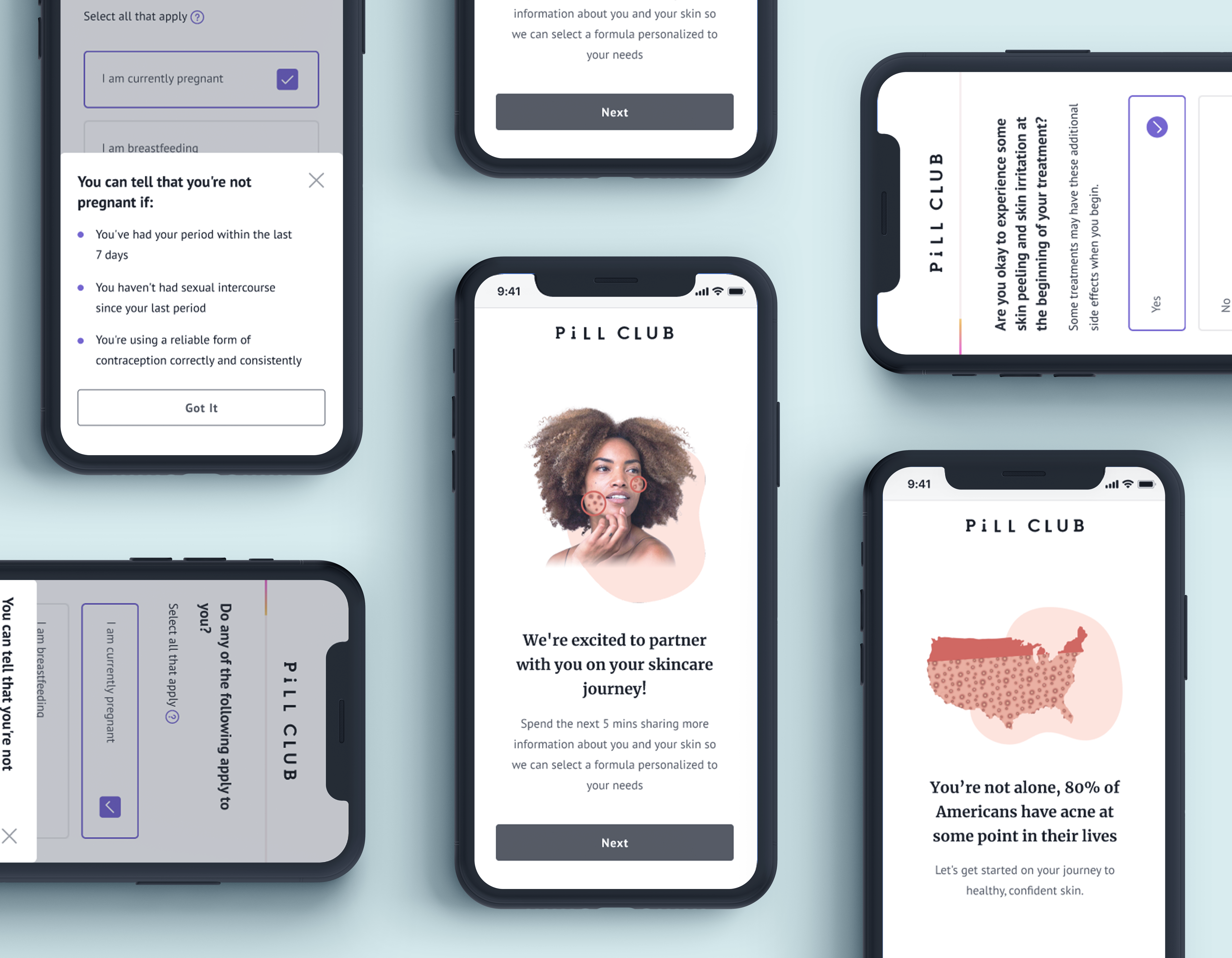
Project Overview
I prototyped dermatology funnel wireframes and interstitial page visuals for The Pill Club’s new skincare feature. Delivered high‑fidelity screens aligned with the design system to simplify complex information, while creating empathetic, accessible interstitials that reduced cognitive load and guided users through the experience.
To launch the new dermatology offering, we needed a medically compliant, low‑friction eligibility questionnaire. Early tests showed users were confused by branching logic and unclear medical terminology, risking drop‑off and misclassification
Tools
Figma, Fullstory, Zeplin, Jira, Adobe Photoshop
Duration
3 weeks, 2021
Role/Team
Myself (Product Design Intern),
Nurah Ali,
Margaret Sommers,
Elaiza Clemens
The Solution
High Fidelity Live Prototype
Engineering adopted the new funnel into the design system within 5 sprints.
Live prototype in figma (clickable)
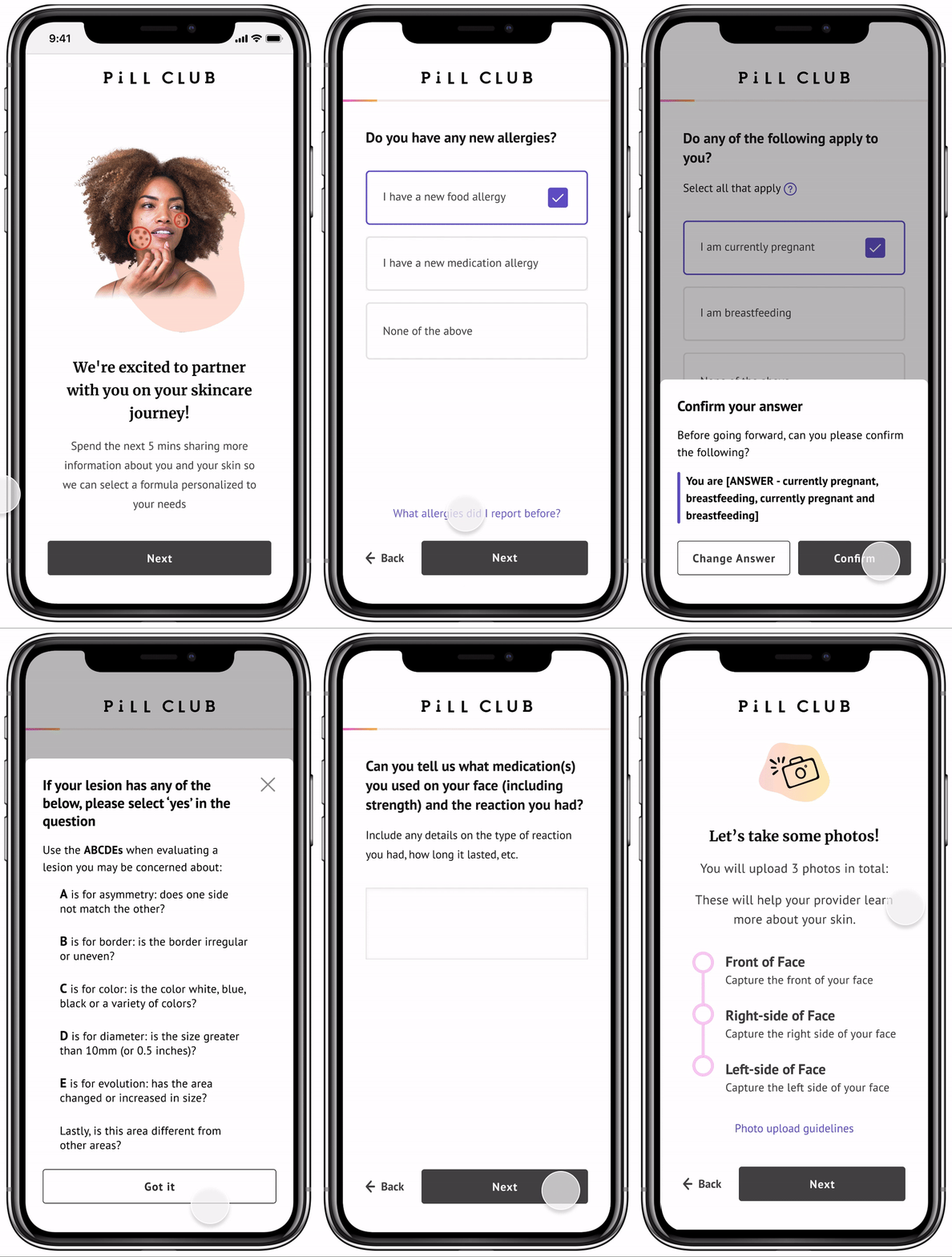
Gif of prototype
User Flow
Studying the Branching LogicAnalyzed questionnaire copy and branching logic to map dynamic user flows and component interactions. Responses determined eligibility, with certain answers triggering additional questions or hard stops.
| Component | When It's Used | Interaction Scenarios |
|---|---|---|
| Radio Buttons | When a question only requires a single response | Single selection only |
| Checkboxes | When a question might have multiple responses | Multiple selections allowed |
| Free Response | When a question requires a unique response the user types in directly | Open text input |
| Pop-ups | Occur in 3 different situations |
Hard Stop
If a user triggers a hard stop, they are asked to confirm their answer in a pop-up.
|
|
More Info (Icon)
If a user selects the more info icon, a pop-up provides an explanation related to the question.
|
||
|
Hyperlink (Text)
Same interaction as More Info, except the trigger is hyperlinked text phrased as a question from the user's perspective.
|
Interface Design
Learning from Birth Control Product
The birth control funnel had a
27% drop‑off
at medical eligibility questions
→
our goal was to reduce this for dermatology.
As my first project with The Pill Club, I immersed myself in the product and design system to quickly learn their interface and backend components. This foundation allowed me to communicate effectively with senior designers and product managers, while ensuring the new skincare onboarding experience carried the same simplicity, accessibility, and brand identity as the birth control questionnaire.

Brainstorm Imagery
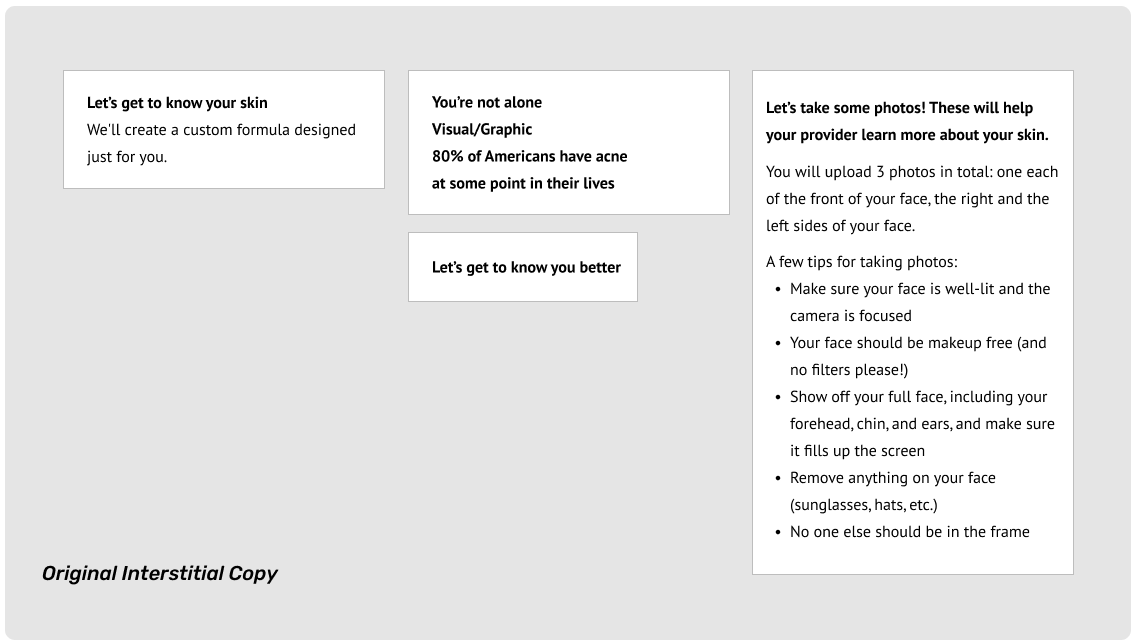
Graphic Designing Interstitial ThumbnailsBrainstormed visual scenarios for interstitial pages and built low‑fi iconography examples in Figma. Brand required illustration styles to match existing birth control assets. Collaborated with the brand team to refine visual communication, then advanced to Adobe Creative Suite to create higher‑fidelity illustrations aligned with The Pill Club’s identity.


Reflections and Next Steps
This project reinforced the value of designing with both clinical accuracy and user clarity in mind. Working within medical constraints pushed me to simplify complex decision trees into an experience that felt approachable, trustworthy, and fast for users while still meeting the needs of dermatology providers. It also highlighted how essential cross‑functional alignment is when translating medical logic into UI patterns that engineers can implement reliably.
If I were to continue developing this feature, I’d focus on deeper usability testing with a broader range of skin concerns, refining the branching logic to reduce cognitive load, and exploring ways to surface provider‑level insights earlier in the flow. There’s also an opportunity to strengthen personalization and transparency so users better understand how their answers shape the recommendations they receive.


Ellis Aguilar 2026